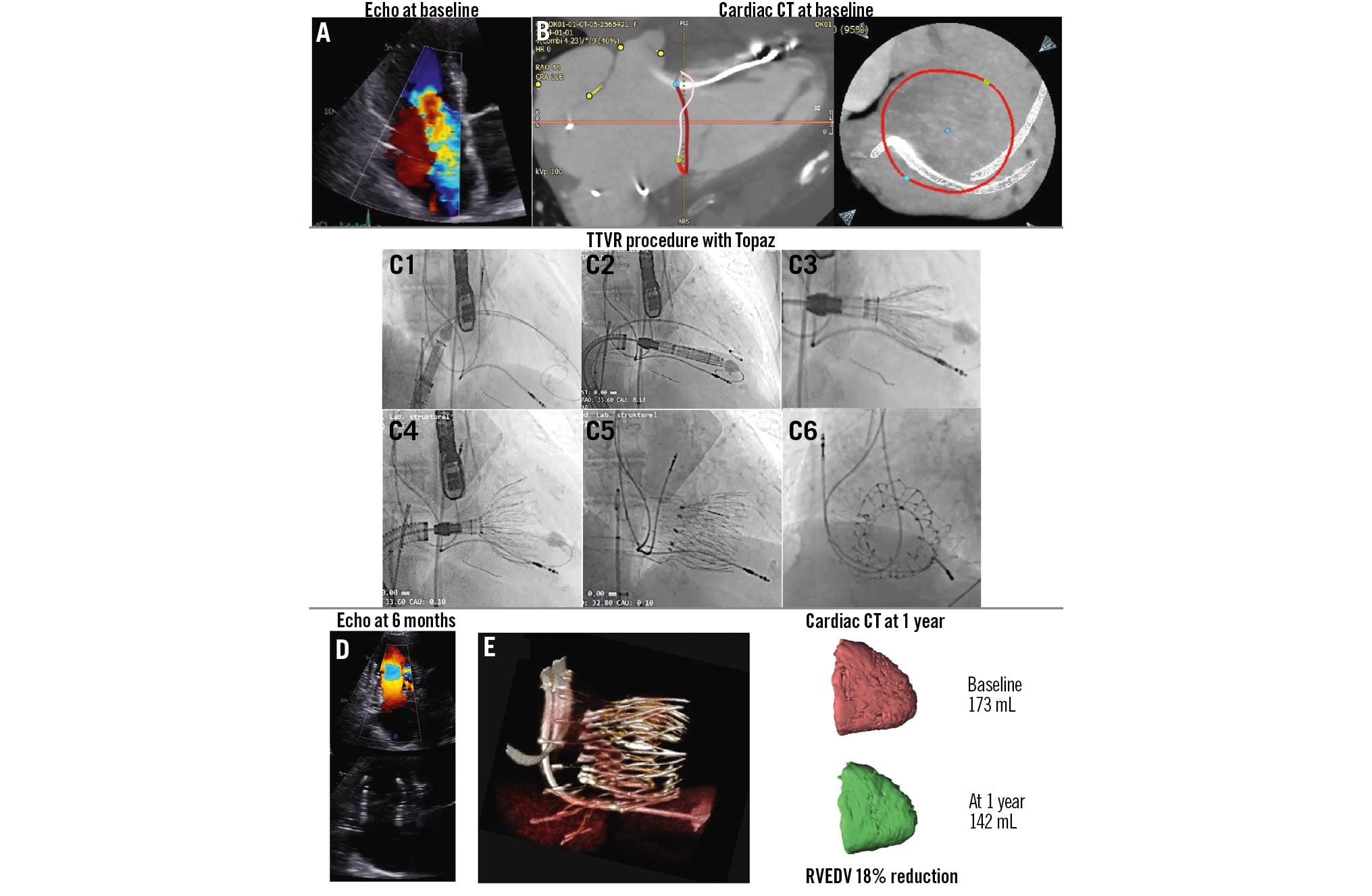
Screening, implantation, and follow-up of the Topaz TTVR System in a patient with a pre-existing pacemaker lead crossing the tricuspid annulus. A) Baseline echocardiography revealed massive TR in the presence of a high-reaching Eustachian valve. B) Baseline CT showed an RV lead traversing the tricuspid annulus at the posteroseptal commissure. C) TTVR procedure with Topaz. C1) The valve crimped onto the delivery system was advanced via the steerable sheath through the tricuspid annulus. A wire in the right coronary artery served as a landmark for the tricuspid annulus during positioning. C2) After correct positioning of the catheter, the height of the prosthesis and the perpendicular alignment with the tricuspid annulus were assessed using multiplanar transoesophageal echocardiography and fluoroscopy. C3, C4) After accepting the valve position, the valve was deployed from bottom to top under fast pacing, starting with the ventricular part of the prosthesis and followed by the atrial part of the prosthesis. C5, C6) The final angiography demonstrated excellent results: no residual leakage, a circular inner ring/stent, and an outer ring well conformed and adapted to the anatomical annular shape in the en face view. D) Transthoracic echocardiography at 6 months confirmed the correct positioning of the prosthesis and a complete elimination of TR. E) CT imaging at the 1-year follow-up shows the trajectory of the pacemaker lead in relationship to the heart valve prosthesis. The RVEDV decreased by 18%, from 173 ml at baseline to 142 ml at 1 year. CT: computed tomography; RV: right ventricular; RVEDV: right ventricular end-diastolic volume; TR: tricuspid regurgitation; TTVR: transcatheter tricuspid valve replacement
Learning objectives
- To recognise guidewire entrapment early during percutaneous coronary intervention of severely calcified coronary lesions
- To demonstrate the feasibility of transcatheter tricuspid valve replacement (TTVR) in the presence of a pre-existing right ventricular pacemaker lead
- To highlight key procedural considerations related to pacemaker lead jailing
- To report early and midterm outcomes, including pacemaker function following TTVR with lead jailing
Cardiac implantable electronic devices (CIED) play a significant role in the management of patients with tricuspid regurgitation (TR). In patients with a pre-existing transvenous permanent pacemaker lead, CIED may contribute to the development or progression of TR and should therefore be carefully considered during both device selection and procedure planning. Furthermore, the prevalence of CIED-related TR is increasing, largely driven by the widespread use of right-sided intracardiac leads.1 While short-term outcomes associated with pacemaker lead jailing during transcatheter tricuspid interventions have been reported as favourable, the long-term safety and durability remain uncertain. Case-based evidence may provide valuable insights into procedural feasibility, potential complications, and mid- and long-term outcomes associated with lead jailing strategies.2
Case summary
An 84-year-old female presented with massive TR grade 4/5 of mixed origin and mild left ventricular systolic dysfunction (left ventricular ejection fraction [LVEF] 45%). The TR was partially atrial secondary and partially lead induced by a pacemaker lead displacing the septal leaflet, thereby preventing adequate leaflet coaptation. The patient remained symptomatic with dyspnoea (New York Heart Association Class III) despite optimal medical therapy. Her medical history was notable for amiodarone-induced pulmonary fibrosis and chronic renal failure (estimated glomerular filtration rate <30 mL/min/1.73 m²), the latter precluding participation in clinical studies. Additional comorbidities included arterial hypertension, permanent atrial fibrillation, and sinus node dysfunction for which a permanent pacemaker had been implanted in 2019. As the patient was not pacemaker dependent and the right ventricular lead was traversing the tricuspid annulus at the posteroseptal commissure (Visual Summary), transcatheter tricuspid valve replacement (TTVR) without lead extraction was considered feasible. The patient had a TRI-SCORE of 5/12, corresponding to a predicted in-hospital mortality rate of 14%.3 Due to leaflet malcoaptation and restriction of the septal leaflet, transcatheter edge-to-edge repair was not considered feasible. The only commercially available TTVR device was not an option as the case was not approved by the manufacturer. Following approval by the Danish Ministry of Health, the patient was treated under a compassionate-use programme with the Topaz TTVR System (TRiCares GmbH). The Topaz system is specifically designed to accommodate the anatomical characteristics of the tricuspid valve. It consists of a flexible outer stent with low radial force, allowing for the preservation of annular dynamics and adaptation to the non-circular geometry of the tricuspid annulus, combined with a rigid inner stent to maintain valve competence.4 The compliant outer stent may also reduce mechanical interaction with existing intracardiac leads. Compared to other TTVR devices, the Topaz system offers the advantage of not requiring leaflet capture, which may simplify the procedure, particularly in cases with tethered or torn leaflets, and may reduce the need for extensive intraprocedural imaging. Additionally, the soft stent design of the Topaz device may confer further procedural and anatomical advantages. In the present case, the Topaz TC-L device was used (tricuspid mean annulus diameter 44 mm), incorporating a double row of anchoring elements intended to optimise sealing performance, particularly in the presence of a transvalvular lead.
The procedure was performed under general anaesthesia via right femoral venous access. A SAFARI² XS extra-stiff guidewire (Boston Scientific) was advanced into the right ventricle. Preprocedural computed tomography (CT) was used to determine the optimal implant angulation and to assess the spatial relationship between the right coronary artery and the tricuspid annulus. A 0.014 inch guidewire was placed in the right coronary artery as a fluoroscopic landmark. The delivery system containing the prosthesis was advanced through a steerable sheath. After confirmation of appropriate positioning with respect to coaxiality, centrality, and implantation height relative to the annulus, deployment was performed in a controlled bottom-to-top release under fast pacing (140 bpm). The total procedure time, defined as the time from delivery system insertion to its removal, was 31 minutes. The prosthesis was successfully implanted in the intended position, with the right ventricular pacemaker lead remaining in situ. Postprocedurally, TR was completely eliminated (grade 0), with no evidence of para- or perivalvular leakage. No periprocedural adverse events occurred. On day 1 post-intervention, the LVEF was measured to be 55% with no TR, and the patient was discharged on day 5.
At the one-month and six-month follow-ups, echocardiography confirmed sustained elimination of TR (grade 0) with no evidence of para- or perivalvular leakage. RV systolic function, as assessed by RV fractional area change and tricuspid annular plane systolic excursion (17 mm), remained stable and within the normal range following the intervention. The pacemaker function remained unaffected, with stable lead impedance and appropriate sensing and pacing parameters. The patient remained asymptomatic from a cardiac perspective. At one-year follow-up, CT demonstrated a stable position of the Topaz prosthesis and evidence of reverse remodelling, with an 18% reduction in right ventricular end-diastolic volume compared to baseline. Pacemaker function remained stable with unchanged lead impedance and preserved sensing and pacing performance.
Discussion
TTVR is emerging as a promising therapeutic option for patients with severe symptomatic TR who are at high or prohibitive surgical risk. However, the presence of a pre-existing CIED lead traversing the tricuspid annulus represents a significant procedural and technical challenge.
In the present case, TTVR was successfully performed despite the presence of a transvalvular pacemaker lead, which was intentionally jailed by the prosthesis. This approach required meticulous preprocedural planning, including multimodal imaging and a detailed assessment of the spatial relationship between the lead, tricuspid annulus, and surrounding structures. A back-up strategy was developed for potential lead dysfunction after TTVR. In such a scenario, the existing lead would be left in place and a leadless pacemaker implanted.
Importantly, the pacemaker function remained stable following the procedure, with preserved sensing and pacing parameters and unchanged lead impedance at follow-up. These findings are reassuring and consistent with emerging case-based evidence suggesting that lead jailing during TTVR may be feasible without immediate functional impairment. In line with the TRIPLACE registry, which demonstrated the feasibility of TTVR in patients with transvalvular CIED leads despite a higher risk of residual regurgitation and lead dysfunction with jailed leads,5 the present case showed a favourable outcome without these complications.
Nevertheless, the long-term safety and durability of this approach remain uncertain. Potential concerns include late lead dysfunction, insulation damage, or mechanical interaction between the lead and the prosthesis over time. Furthermore, lead extraction, if required in the future, may be significantly more complex or even impossible in the presence of a transcatheter valve prosthesis.
This case highlights that, in selected patients, TTVR with intentional lead jailing can be performed safely with careful planning and appropriate device selection. However, systematic data and longer-term follow-up are required to better define the risks and inform optimal management strategies in this growing patient population.
Conclusions
This case highlights that TTVR with Topaz in the presence of a transvalvular pacing lead is feasible and can be performed safely with appropriate planning. Nevertheless, careful patient selection and close follow-up are warranted, and further data are needed to better define the long-term implications of lead jailing.
Impact on daily practice
This case demonstrates that transcatheter tricuspid valve replacement with the Topaz system is feasible in the presence of a transvalvular pacing lead and can be performed safely with meticulous procedural planning. Careful patient selection, comprehensive preprocedural assessment, and structured follow-up remain essential. Further clinical data are required to better define the long-term safety and implications of pacemaker lead jailing in this setting.
Consent statement
Written informed consent was obtained from the patient for publication of this case report and any accompanying images.
Funding
This case was performed under compassionate use. The device was provided by TRiCares, and no additional funding was received.
Conflict of interest statement
O. De Backer received institutional research grants and consulting fees from Abbott, Boston Scientific, and Medtronic. J.E. Møller received institutional research grants from Johnson & Johnson MedTech Heart Recovery and the Novo Nordisk Foundation, and was a member of the Boston Scientific advisory board. The other authors have no conflicts of interest to declare.