Transcatheter tricuspid valve replacement (TTVR) has emerged as a transformative approach for patients with severe tricuspid regurgitation (TR). As the field matures and clinical experience grows, important procedural nuances have come to the forefront. Among these, the management of cardiac implantable electronic devices (CIED) represents one of the most clinically relevant challenges. Conduction abnormalities are common following TTVR in pacemaker-naïve patients, with new pacemaker implantation rates ranging from 6% to 29%, depending on the device used.1 In patients with pre-existing pacemaker or defibrillator leads traversing the tricuspid annulus, the complexity is compounded further. In both randomised controlled trials and real-world registries, TTVR is increasingly being performed in patients with pre-existing CIED leads traversing the tricuspid annulus. However, the best management of these leads – whether to jail or extract – remains an open and clinically important question.
In this issue of EuroIntervention Case Reports, Burup Kristensen et al report an interesting case of TTVR using the novel Topaz system (TRiCares GmbH) in a patient with severe TR and a pre-existing CIED lead.2 The procedure was performed successfully, with complete TR resolution (from massive [grade 4/5] to none [0/5]) and no compromise of lead integrity or pacemaker function. A 6-month follow-up confirmed sustained TR resolution with no paravalvular leak (PVL), stable CIED lead parameters, and no change in right ventricular function (normal). This case contributes meaningfully to the emerging body of evidence on TTVR feasibility in patients with existing transvalvular leads and introduces the Topaz system as a viable option in this anatomically challenging scenario.
The Topaz system represents a notable addition to the growing armamentarium of transcatheter tricuspid technologies. Developed for transfemoral delivery with a 29 Fr steerable sheath, it features a self-expanding nitinol frame with a two-stent design. While the outer stent is soft and anchors the prosthesis to the tricuspid annulus, the inner stent is more rigid – to maintain a circular shape – and houses a porcine pericardium three-leaflet valve. The annular anchoring mechanism does not rely on leaflet grasping or radial force, but rather on an hourglass shape (v-groove) and 12 atraumatic anchors. Its frame architecture is engineered to accommodate the complex, non-circular tricuspid annulus and to have minimal impact on right ventricular function. The case reported here highlights the system’s adaptability in the presence of a CIED, suggesting that its frame geometry may allow for adequate sealing around transvalvular leads.
The central management dilemma in TTVR candidates with existing leads revolves around a fundamental choice: jail the lead with the prosthesis or extract it before valve deployment. The recently published TRIPLACE paper provides the most comprehensive data to date on lead jailing during TTVR, demonstrating procedural feasibility but also highlighting a non-trivial rate of PVL attributable to lead interference with valve sealing, as well as single-digit rates of lead failure at follow-up (6% at 1 year).3 Lead extraction, on the other hand, is not without risk: procedural complication rates, including vascular injury, cardiac perforation, and haemodynamic compromise, are well-documented, particularly for older or fibrosed leads. Furthermore, for leaflet-based TTVR technologies that depend on native leaflet integrity for anchoring, lead extraction carries the additional risk of leaflet avulsion, potentially rendering the patient ineligible for the intended TTVR implantation strategy. Taken together, the single-digit rates of lead failure observed with jailing and the non-negligible risks of extraction do not support a universal “extract-them-all” strategy. Rather, decision-making must be individualised within a dedicated multidisciplinary Heart Team (i.e., interventional cardiologists, cardiothoracic surgeons, electrophysiologists, imaging specialists, and heart failure specialists) weighing factors such as the patient’s pacing dependency, lead age and adherence, extraction risk profile, comorbidity burden, and the specific TTVR system under consideration (Figure 1).
Looking ahead, the expanding landscape of TTVR systems raises important device-specific questions regarding lead coexistence. Moderate or greater PVL has been associated with adverse prognosis after TTVR,4 yet it remains unclear which prosthesis design might best mitigate this risk in the presence of a CIED lead. A softer frame with low radial force may conform more readily around the lead, improving annular sealing, but the same compliance might render the frame vulnerable to deformation by the lead itself at each cardiac cycle, leaving a significant gap between the prosthesis and the tricuspid annulus. Careful preprocedural assessment of lead position, trajectory, and slack will therefore be essential in guiding device selection. Beyond sealing, the impact of prosthesis characteristics on lead longevity warrants consideration: theoretically, a device with low radial force may exert less chronic friction and mechanical stress on the lead, potentially reducing the risk of lead failure over time, though this hypothesis remains to be tested prospectively. Finally, the question of lead extraction after TTVR, long considered technically unfeasible, deserves reappraisal. A published case has demonstrated successful lead extraction following EVOQUE (Edwards Lifesciences) implantation,5 and as further data accumulate, this option may meaningfully expand the permutations of lead management available to the Heart Team, both at the time of TTVR planning and during long-term follow-up.
The field of transcatheter tricuspid intervention stands at an exciting inflection point. With one system now commercially available and several others rapidly advancing through early feasibility and pivotal studies, the pace of innovation has been remarkable, and the case reported here exemplifies this spirit precisely. The Topaz system’s performance in the presence of a CIED lead is an encouraging signal, and with rigorous data collection and collaborative investigation, the boundaries of what is achievable in tricuspid valve disease will continue to expand. Each challenging case successfully navigated, each novel system thoughtfully evaluated, and each multidisciplinary decision carefully made brings us closer to a future where severe TR is no longer undertreated, and no patient is deemed ineligible for a meaningful intervention.
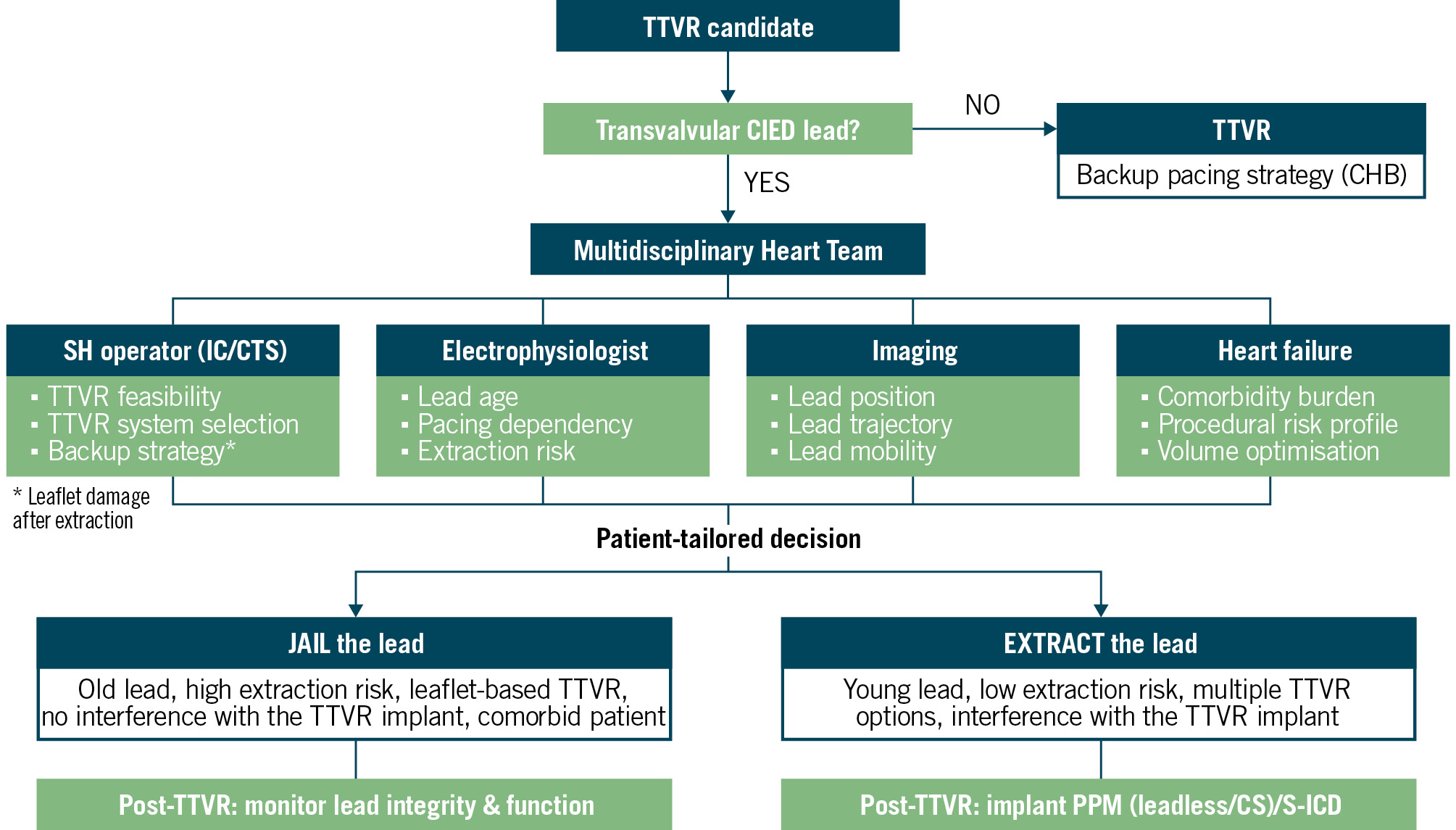
Figure 1. Lead management in TTVR candidates. CHB: complete heart block; CIED: cardiac implantable electronic device; CS: coronary sinus; CTS: cardiothoracic surgeon; IC: interventional cardiologist; PPM: permanent pacemaker; S-ICD: subcutaneous implantable cardiac defibrillator; SH: structural heart; TTVR: transcatheter tricuspid valve replacement
Conflict of interest statement
A. Scotti serves as Deputy Editor of EuroIntervention Case Reports and declares no conflicts of interest related to this work. A. Latib has served on advisory boards for Supira, Medtronic, Abbott Vascular, Boston Scientific, Edwards Lifesciences, Shifamed, NeoChord, VDyne, Philips, Centerline Biomedical, VahatiCor, Advanced Nanotherapies, NuevoSono, Anteris, T45 Labs, Tioga, and Nyra Medical.